Hand Talk:
Beyond words
Classes teach toddlers an array of gestures for communicating
By JAN HOGAN
VIEW STAFF WRITER
By JAN HOGAN
VIEW STAFF WRITER
They can ask for a bottle of milk. They can announce they dropped their blankie. And when a diaper change is needed, they'll let mom or dad know.
It's all done without uttering a sound.
Just because babies are too young to speak doesn't mean they can't communicate. They can use sign language to make their needs known.
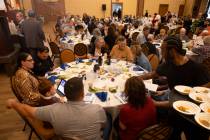
Shannon Osborne teaches families to talk with their hands through her business Wee Can Sign. Osborne recently spoke to a class at Summerlin Hospital. Of the 12 adults who attended, three were fathers. The infants ranged in age from 2 to 10 months.
"We're here because I think it's an interesting idea that babies can learn to sign before they can verbalize," said Brenda Halter, a Summerlin resident who brought her 8-month-old son Jonah. "Besides, it's a way to get him out and socializing with other babies."
Adi and Sara Barshishat brought their 7-month-old son Dotan.
"It might take a couple months before he gets it," Adi Barshishat said. "But we're determined to keep signing with him until he signs back. As a parent, you want to know what your child is feeling. Otherwise, you wouldn't know if something was wrong, if he was in pain or not."
His wife added that the initial words she planned to teach Dotan were for food.
Melissa Rozhon brought her 10-month-old son Elijah.
"When he's crying, it's frustrating because I don't know what he wants," she said. "Signing will help him communicate. Right now he does these special sounds and I can pretty much pick up (what he needs) that way. It's whining, but it's all different. But I'll be glad when he starts signing."
A colored mat was set up on the floor for the babies, while the parents sat in a semi-circle. Osborne started the class with a casual military salute.
"I just said 'hello' to you," she told the parents and had them repeat the gesture.
She gave more signs -- sun, stars, book, toy. Each time she used a new gesture, Osborne voiced the definition aloud and explained how it came about. The sign for bird, for example, was like a beak. She then repeated it a couple of times. Doing it that way made it easier to connect the gesture with the meaning, she said.
The sign for book was pressing the palms together, then opening them as though they were hinged along the little fingers. And the sign for milk was derived from milking a cow. Osborne asked if anyone had any idea what the sign was for changing a diaper.
"How about this?" Brock Halter said.
He held his nose jokingly.
During a video, jingles were heard while people signed to the words. Voice-overs of young children explained easy ways to remember the sign. Then parents were shown giving testimonials on teaching their children to sign. One father told of changing his son, putting him in the car seat, only to have him sign that he indeed needed another diaper change.
Parents kept one eye on the video monitor and the other on their babies, at times offering a feeding or conducting a diaper change. They paused to mimic the signs.
The sign for water was tapping the chin with the third finger. Music took its gesture from an orchestra conductor. Up -- or pick me up -- depending on the circumstances, was conveyed by pointing one finger at the sky.
While the parents struggled to remember all of the signs, Osborne warned them that sometimes babies sign backward or, due to lack of motor skills, present their own version of the sign. That's OK, Osborne said.
"My wife and I, we're both left-handed," Brock Halter said. "We're hoping he's left handed, too, so he can understand what we're saying."
Osborne assured them their child would do whatever came easiest for him and the family would easily understand one another's signs. Most 8- to 9-month-old children have the fine motor skills necessary to control their hands.
"This has to become a part of your life," Osborne told the parents. "You have to repeat it over and over. Patience and repetition are key. Babies pay attention to everything around them. They will see you're doing something new with your hands and pretty soon, they'll start signing back."
Osborne became interested in signing after seeing a report on ABC-TV's "20/20." She found out more on the Internet. Her son Eli, 6, learned to sign at 10 months old.
Wee Can Sign classes take place at locations such as pre-school centers, The Women's Care Center in Henderson, the Jewish Community Center, the child development center at Nellis Air Force Base, and Family to Family Connection on West Charleston Boulevard. Some are introductory classes. Others, like the one at Summerlin Hospital, run for four weeks.
Osborne leads classes as small as two or three families or as large at 12 families. She began offering classes in 2003 and estimates her sessions have taught 1,300 people.
Each class includes a DVD or video tape, an alphabet poster and a workbook containing 145 signs. And there are homework assignments.
"You'll see (graduates of this class) at our toddler support program," said Kristin Rafie, childbirth education coordinator at Summerlin Hospital. "They sign as they talk. It's really interesting to watch."
Sign language for infants has proven useful for more important things than asking for a cookie. It has saved at least one life.
"Before she was old enough to talk, my friend's daughter Leah signed her mother the words 'coin,' 'stuck' and 'brown,' and she realized Leah was choking," said Osborne. "The 'brown' was because it was a penny. I mean, to be able to tell someone the color of the coin when you're choking, that's pretty good."
<<-- [back]